






Mayors and city leaders.
The first principle asks that AI be led from the top of the city, not left to the IT department. Sign the Declaration, take the four first moves and bring your city to the review.
THE LICHTENSTEIG DECLARATION ON LIVING CITIES AND AI · FOR PUBLIC REVIEW
Ten principles for making a city wiser with AI, not only faster, with people in charge.
Read the ten principles, sign the Declaration and help shape what comes next.
Convened by Living Cities Earth and Global Mayors Academy through the Global AI Summit for Cities.
AT A GLANCE
Short enough to remember, specific enough to use when a contract lands on the desk. The full text, with a note on what each principle means for a city, is further down.
Colours group the principles by theme; the Declaration itself lists them in order.
TOGETHER
AI is a question for the mayor and the whole city, not only the IT department.
TOGETHER
Use AI to hear more voices, above all the least heard, and to act together.
LIVING PLANET
Use AI to care for water, air, soil and green space, and count what AI itself consumes.
HUMAN CAPABILITY
The more AI can do, the more the city invests in what people do well.
HUMAN CAPABILITY
The time and money AI frees go back into people, care and nature, decided in the open.
LIVING PLANET
Never faster or cheaper at the cost of rights, nature or the city’s future.
PEOPLE IN CHARGE
Decide where the people affected are. No single model fits every city.
PEOPLE IN CHARGE
The city’s data and know-how stay under local control, with no supplier lock-in.
PEOPLE IN CHARGE
Every system has a named owner. Every decision can be explained, challenged and put right.
TOGETHER
Try, share what fails, revise. Never use AI to manipulate people covertly.
WHY NOW
A chatbot for the call centre. A dashboard for traffic. A supplier’s offer that is hard to refuse. None of these feels like a turning point. Together they decide whom the city’s intelligence will serve. The Declaration asks that question out loud, before the contracts are signed.

By default
The heat sensors had recorded the rising temperatures for years, yet the hottest streets were those whose residents rarely take part in consultations. A bookshop that served the neighbourhood for thirty years closed because people’s assistants rarely recommended it. Nobody decided any of this. It added up.

By choice
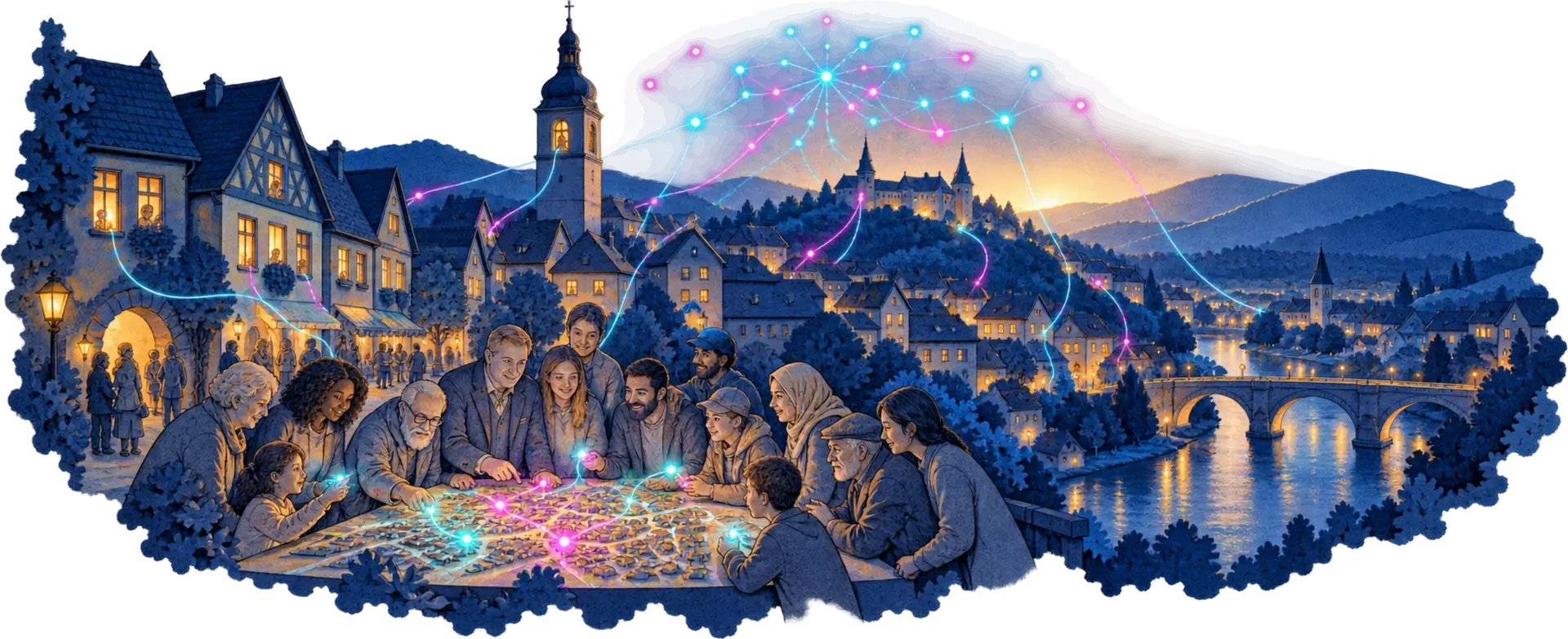
When the heat data rose, the city brought it together with what residents knew about their streets and with ideas from local businesses and young people. Within weeks it decided together where shade, water and trees should go. The time AI had freed at city hall went into exactly this work.
Adapted from the opening of Cities After AI, the white paper behind the Declaration.
Every AI system used in the city has an owner who answers for it. A decision that affects people can be explained, reviewed and challenged, and put right.
People and organisations can move their data to another provider, and open standards protect the city from depending on any single one.
AI helps the city hear more of its voices, above all those least heard today. Technology strengthens participation; it does not replace it.
Efficiency gains never override fundamental rights, ecological limits or long-term viability. Traffic that moves faster while the streets empty of people is not progress.
JOIN · STARTING TODAY
You can start today. Each way is open to a person, an organisation or a city.
Sign the Declaration and share your view, as a person, an organisation or a city.
Join the open review and learn alongside other cities: dialogue, exchange of experience, research and leadership development. Online, free, from any city.
Run a pilot in your own field, in AI systems, leadership, community life or ecological regeneration, and share what you learn, including what did not work.
FOR MAYORS AND CITY TEAMS
Cities After AI, the white paper behind the Declaration, proposes first moves any city can take. Here are four of them, small enough to start this month.
Put AI on the leadership agenda. Bring senior leaders together with business, education and civil society to look at how AI is already changing the city.
Principle 1Pick one challenge no single institution can solve. Start from the problem and the people it affects, not from the technology.
Principle 2Make one system’s benefits and responsibilities visible. For one AI system the city already uses: who gains, who bears the costs, who answers for it and where the freed time goes.
Principles 5 and 9Find partners to learn with. Universities, businesses, communities and other cities, sharing what works and what does not.
Principle 10A city that takes these four moves is already living by the Declaration, with or without a signature.
BEFORE YOU SIGN
FIND YOUR WAY IN
The first principle asks that AI be led from the top of the city, not left to the IT department. Sign the Declaration, take the four first moves and bring your city to the review.
Under each principle you will find what it means in practice: a plain-language card for one system, a channel for residents’ views, contracts without lock-in and an exit clause written in from the start. The Commitments, layer 3 of the framework, list the evidence.
Sign the Declaration as an organisation, learn alongside cities and run a pilot in your own field. In return, cities can offer one set of expectations shared by many of them, instead of a different rulebook in every tender.
Nothing is required of you. The Declaration asks AI to help the city hear more of its voices, above all those least heard today, and it names young people among the voices that shape AI in a city. Give your view in the review. For anyone under 18, separate rules for data and consent come before any pilot.
Researchers, journalists and funders: the reasons and the evidence are in Cities After AI, the white paper behind the Declaration. Read the white paper
THE TEXT · FOR PUBLIC REVIEW
Artificial intelligence is changing not only what cities can do, but what cities are. Its consequences will depend not on technology alone, but on the choices we make together.
A city is a living system: people, communities, businesses, institutions, infrastructure and the natural world, now joined by increasingly capable AI systems. Its government is one voice among many. Cities are also part of a living planet. Human flourishing depends on the health of the living systems that sustain it, and the test of any arrangement of people and AI is whether it helps both to thrive. This is what we mean by human- and planet-centred AI.
AI can create a substantial dividend of time, attention, resources and new capabilities across the city: in government, in businesses, in communities and in people’s daily lives. It can also absorb resources, intensify workloads or carry its benefits elsewhere. How this dividend is created, distributed and reinvested will help determine whether cities become more capable of shaping their own futures, or more dependent, divided and fragile. Inaction is not a neutral option. Neither is uncritical acceleration.
We believe the deepest promise of AI for cities lies beyond faster services. It is the possibility of expanding their collective intelligence and capacity to act: to hear more of themselves, understand shared challenges, coordinate better and learn faster, while people keep authority, responsibility and the right to say no. Any city, large or small, can take this path. None has to take it alone.
There is no single model of the city after AI, and much of what lies ahead is still unknown. We therefore commit to shared principles, and to discovering together how they can best be met.
Choose the future together. AI is a matter for the whole city, not an IT project. It is led at the highest level of political and civic leadership and shaped together with all of the city’s voices: government, business, civil society, residents, young people and those who build AI. This calls for leaders who think in systems, work across sectors and steward the long term.
What it means for your city
AI is not something to hand to the IT department and check on once a year. The mayor and the council own the question, and the people it affects shape it from the start: businesses, community groups, schools, young people and the companies that build the tools. In practice a city puts AI on the agenda at the top, names who leads it, and opens the table before the first large contract, not after.
Strengthen the city’s collective intelligence. AI helps cities hear more of their voices, above all those least heard today; understand their shared challenges; bring different perspectives together; and coordinate collective action. This includes understanding the condition of the natural systems on which urban life depends. Technology strengthens participation and cooperation; it does not replace them.
What it means for your city
Most cities hear the same few voices: those with time for evening meetings and the confidence to speak. AI can widen that circle by gathering views in many languages and at any hour, summarising thousands of comments and showing where neighbourhoods agree. It can also help a city read the state of its rivers, trees and air. The test is simple: more people take part, and no one's seat at the table goes to a machine.
Learn to flourish within a living planet. Cities are part of the living systems that sustain them, and are still learning how to thrive with them. We use AI to understand our ecological relationships better, to protect and regenerate ecosystems, and to shape urban development that strengthens both human and planetary flourishing. We take responsibility for the energy, water, materials and land that AI itself requires.
What it means for your city
A city lives on its water, soil, air and green spaces, and AI can help it see them more clearly: where heat builds up, where floods will run, which habitats are fragile. The same principle counts the footprint of AI itself. Data centres need power, water, materials and land, so before it buys a system a city asks what it will consume and weighs that against what it gives back.
Grow human capability. As AI becomes more capable, we deliberately develop the human capacities needed for wise collective choices: judgement, creativity, empathy, cooperation and responsibility. Cities invest in lifelong learning, and some things they deliberately choose not to automate.
What it means for your city
The more AI can do, the more it matters what people do well: weigh a hard choice, imagine something new, understand someone else, work together and take responsibility. A city keeps training its staff and residents rather than letting those skills fade. It also decides, out loud, what stays human: a conversation with a family in crisis is not a task to automate.
Reinvest the AI dividend, and share it widely. Public institutions reinvest the time, attention and resources AI frees in people’s capabilities, prevention, care, participation and the regeneration of nature, and they decide how transparently, with the city’s voices. Across the city, businesses, institutions and communities work together so that the benefits of AI are widely shared rather than simply cashed out or captured elsewhere.
What it means for your city
AI frees time, attention and money. This principle says where they go: into people's skills, prevention, care, participation and the repair of nature, not simply into savings. The city decides openly, with its residents, and reports for each significant system what was freed, where it went and what changed. Local businesses and communities should feel the gain too, not only shareholders far away.
Put long-term health before optimisation. Efficiency gains never override fundamental rights, ecological limits or long-term viability. We consider how improvements in one part affect the health of the whole city and of the larger living systems it belongs to, and we make trade-offs openly and responsibly.
What it means for your city
AI can make almost anything faster or cheaper. This principle says what a saving may never cost: people's rights, the limits of the natural world, the city's ability to keep going. A faster service that empties a neighbourhood, or a cheaper one that uses ever more water, is not progress. Before a significant system goes live, a city writes down who gains, who bears the costs and what must not be traded away.
Decide close to people; honour local identity. Decisions are taken as close to the people affected as competence allows, while public institutions retain the authority the common good requires. Each city finds a path that fits its own culture, history and needs.
What it means for your city
A neighbourhood decides what a neighbourhood can decide; a school, a community, a district likewise. The city keeps the authority the common good requires and does not centralise what works better close to people. There is no single model to copy: each city shapes its use of AI around its own culture, history and needs.
Keep the city in charge of its intelligence. Cities preserve local agency over the data, knowledge and AI capabilities that shape urban life. People and organisations hold appropriate rights over their data and can move it to another provider. Public-interest data is stewarded for the common good, and open standards protect cities from dependence on any single provider.
What it means for your city
The data the city collects, the knowledge its staff build up and the AI tools it relies on stay under local control. Residents and organisations can take their data to another provider. In practice this is a procurement question: contracts without lock-in, open standards, export formats and an exit clause written in from the start, so that no single supplier ends up holding the city's memory.
Make AI answerable to people. Every AI system used in the city has an identifiable owner who is accountable for it, and is open about whose interests it serves. AI that acts on someone’s behalf serves that person’s interests, not those of its provider. Decisions that affect people can be explained, reviewed and challenged, with effective correction and remedy. Public AI systems are listed openly.
What it means for your city
Behind every AI system in the city there is a named owner who answers for what it does, and the system says whose interests it serves. An assistant that acts for a resident works for that resident, not for the company that supplies it. Anyone affected by a decision can ask how it was made, have it reviewed, dispute it and get it put right. The city keeps an open list of its public AI systems, with a plain-language card for each.
Evolve together, expanding freedom. Cities experiment, share what works and what fails, and revise these principles as evidence grows. We favour AI that expands people’s opportunities and freedom over AI that restricts them, and we never use AI to manipulate people covertly.
What it means for your city
Nobody has a complete answer yet, so cities try things, share what works and what fails, and the principles change as the evidence grows. Given a choice, a city prefers the system that widens people's options over one that narrows them. One line is never crossed: AI is never used to manipulate people covertly. A city that switches a system off and says why has done something worth copying.
This is a living document. Every version is published, with each change and the reasons for it, including any dissent. These principles are commitments. How best to meet them remains an open question. Practical approaches, including rules for how AI agents should behave in cities, will be developed as hypotheses and tested in real pilots before anything is proposed as a standard. Signatories pursue these principles within their own mandates and legal contexts, and in the ways that fit their circumstances.
The Declaration is shaped in the open. From 31 October 2026, World Cities Day to 12 December 2026, participants of the AI for Cities Global Summit review it voice by voice. Version 1.0 opens for signature on 12 December, in Lichtensteig and online.
There are three ways to take part, each building on the last:
We are not only asking cities to adopt AI responsibly. We invite them to discover, together, what a more intelligent, capable and life-enhancing city can become.
HOW IT IS SHAPED
This is a living document. It is reviewed voice by voice through the Global AI Summit for Cities: government, business, civil society, residents, young people and those who build AI. Every version is published, with each change, the reasons for it and any dissent.
FOR PARTNERS
We are looking for people and institutions who want cities to come through the AI transition stronger, and who will help make this text worth signing.
Scholars and practitioners of cities, living systems, ethics and technology who review the text and the framework beneath it.
Bring your members into the review, so the text is argued over by the cities it concerns.
Help evaluate pilots and turn their results into knowledge other cities can use.
Support pilots in cities that could not run them alone, translations into more languages and the open record of every version.
WHO IS BEHIND IT
The Declaration is shaped through the Global AI Summit for Cities, convened by Living Cities Earth and Global Mayors Academy.
Lichtensteig is the small Swiss town where Global Mayors Academy is based. Like the Montréal Declaration before it, this declaration takes the name of the place where it is shaped, subject to the town’s agreement.
The Declaration sees a city as a living system: people, communities, businesses, institutions, infrastructure and nature, now joined by AI, and part of a living planet. Its government is one voice among many. So the question is not only how city hall can work faster, but how the whole city can hear itself better and thrive.
BEHIND THE ONE PAGE
The Declaration is the first of four layers of AI for Thriving Cities. Each layer opens up the one before it.
Believe
What we believe, on one page.
Understand
Why it matters: the white paper with the reasons and the evidence.
Commit
What a city or organisation does, and how it shows it.
Behave
How AI agents behave: rules an agent can read and follow.

The Global AI Summit for Cities is free and online, from any city. Sign the Declaration, join the review and bring your city’s experience.